Research Article | | Peer-Reviewed

Geological Formations and the Quagmire of Stream Extinction in Southern Nigeria

Received: 29 June 2025     Accepted: 14 July 2025     Published: 9 December 2025
Views:       Downloads:
Abstract

Geology plays a key role in determining the behavior of the ecosystem including its streams network and a better understanding of this concept is the first step toward ecosystem and water sustainability. Hence, this study examines geological formations and the quagmire of stream extinction in Southern Nigeria. Two different geological formations in Southern Nigeria were considered in this study which include the Coastal Plain Sands using Kwa Iboe River in Akwa Ibom State and Basement Complex in some parts of Cross River State. Six matured watersheds were purposively selected from each geological formation (six in Coastal Plain Sands and six in Basement Complex), making a total of twelve (12) watersheds. These cut across Idim Awankwo, Midim, Utu Abak, Anyang, Ibedu and Akpeti watersheds in the Coastal Plain Sands in the Kwa Iboe River and Iwuru, Uyanga, Abonabung, Akor Ako, Okpon and Inyang Iba watersheds in the Basement Complex in Cross River. The result of the summary of the morphometric characteristics shows lower bifurcation ratio in the CPS indicating watersheds in which the geologic structure does not exercise a dominant influence on the drainage pattern while the reverse is the case in BC. In area aspect, the result shows complicated values and high circularity ratio in BC due to the presence of a combination of lithological formations, leading to differential erosion and subsequently to watershed displacement. Statistical analysis using independent t-test analysis shows a p-value of 0.007 which is an indication that there is a significant difference in the morphological parameters of Basement Complex and Coastal Plain Sands as they relate to stream extinction. The summary of the study indicates that streams in the ancient basement complex rocks of Cross River State have restricted area, high values of basin relief and high bifurcation ratio due to inability of streams to erode easily, unlike the weak sedimentary rocks. More so, streams in the CPS recorded less influence from the geological structure of the basins, making the soil have loose particles and highly susceptible to infiltration and highest level of stream extinction. This supports the observable disparity on the basin resilience as one traverse along the river course. Hence, it was recommended that since the CPS is highly prone to stream extinction, desilting the stream channel should be given a priority by stakeholders.

Published in Engineering Science (Volume 10, Issue 3)
DOI 10.11648/j.es.20251003.12
Page(s) 92-103
Creative Commons

This is an Open Access article, distributed under the terms of the Creative Commons Attribution 4.0 International License (http://creativecommons.org/licenses/by/4.0/), which permits unrestricted use, distribution and reproduction in any medium or format, provided the original work is properly cited.

Copyright

Copyright © The Author(s), 2025. Published by Science Publishing Group

Keywords

Geology, Watershed, Stream Extinction, Basement Complex, Coastal Plain Sands

1. Introduction
Streams remains the main source of fresh water supply. The origin and evolution of streams systems can be traced back to the geological history of the Earth under the effects of tectonic and volcanic processes and changes in the global climate. However, the river systems and the hydrographic network in all-purpose are of a great significance for nature and human life, providing people with fresh water for their activities. Therefore, the spatial distribution of river systems, their quantitative features and temporal changes in any region of the world depend on a range of both physiographic and anthropogenic factors. Globally, major water sources are drying up daily . The Yangtze River in China is facing serious threats, including river ecosystem collapse, species extinction, and reduced water quality due to human activities and climate change. Similar situations are seen in Rhine River in Germany, the Mississippi River in the United States, the Nile River, the Amazon, among others. The Aral Sea (located in Central Asia, specifically on the border between Kazakhstan and Uzbekistan) is today known as “the desert of ghost ship” which was once regarded as the earth’s 4th largest inland water mass. An ancient sea so vast that Alexander the Great wrote on his struggles to cross it where fishing commerce boomed, and holiday makers once flocked to its seaside spa town.
Stream extinction denotes cessation of flow of stream network due to environmental or human-induced factors. This occurs when a stream dries up permanently, loses its natural flow, or becomes disconnected from its source. This paper focuses on two major geological formations in southern Nigeria (Coastal Plain Sands and Basement Complex). Basement Complex (BC) geology refers to the oldest, most stable, and deeply buried crystalline (igneous and metamorphic) rock formations that form the foundation of continents. These rocks are typically Precambrian in age (more than 540 million years old) and are often exposed in areas where erosion has removed younger sedimentary layers. The Basement Complex plays a crucial role in mineral, oil, and groundwater exploration due to its unique composition, structure, and geological history. Howbeit, Basement rocks are often rich in valuable minerals because of their long history of metamorphism, magmatism, and tectonic activity. On the other hand, Coastal Plain Sands (CPS) refer to unconsolidated to semi-consolidated sedimentary deposits found along coastal regions. These sediments are typically quaternary to tertiary in age and consist mainly of sand, silt, clay, and gravel. They are formed by marine, fluvial, and aeolian processes, making them an essential part of coastal and deltaic environments.
Geology plays a key role in determining the behavior of the ecosystem including its streams network . For instance, streams in the ancient basement complex rocks of Obudu/Obanliku have restricted area, high values of basin relief and high bifurcation ratio due to their inability to erode easily, unlike the weak sedimentary rocks while the reverse is the case in coastal plain sands. Hence, differences in geology constitutes a constraint on the degree of interdependence amongst the morphometric attributes of drainage basins. As reported by , an increase in the interdependence of the morphometric properties of drainage basins is indicative of a lessening of environmental constraints [lithology] on the stochastic processes that generate stream networks. Many scholars including reported that morphometric characteristics at the watershed scale contain important information regarding its formation and development because it is a representation of hydrologic and geomorphic processes in a watershed. Drainage pattern concept draws inferences on the level of stream extinction. Morphometric parameters which analyzed drainage pattern is based on the hierarchical arrangement of streams in a drainage system which in turn reflects mainly structural or lithologic controls of underlying rocks. Streams are linked to each other and to an outlet in an endpoint, except in some adverse environment.
2. Aim of the Study
The aim of the study focused on assessing the morphological characteristics of watersheds in the Basement Complex and Coastal Plain Sands as they relate to stream extinction in Southern Nigeria.
3. Research Hypothesis
Ho1: There is no significant difference in the morphological parameters of Basement Complex and Coastal Plain Sands as they relate to stream extinction.
4. The Study Area
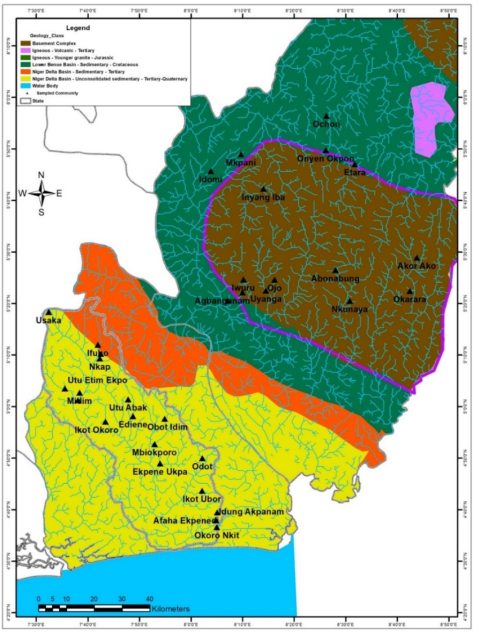
The study area covers the Kwa Iboe River basin in Akwa Ibom State which is under the Coastal Plain Sands geology and parts of Cross River basin dominated by basement complex rock which cover part of Biase, Akamkpa, Yakurr, Obubra, Ikom and Etung local government areas. In the Kwa Iboe River section of the study area, major landforms and relief common in the area comprise shallow depressions and numerous dry valleys. Such depressions are usually inundated during the rainy seasons and many a times create seasonal lakes which serve as major sources of water in the rural communities . The highest relief in the watershed ranges between 150-169m above sea level recorded in Abia State and northern Akwa Ibom. In Cross River State, the study area is under Basement Complex formation. The Basement Complex is an important geological formation in West Africa which has exerted great influences on the relief, hydrology, soils and farming systems of several areas within that sub-region. The 2023 projected population shows that Akwa Ibom State recorded an estimated figure of 6,223,771 persons while Cross River State had a projected population of 4,406,200 at an annual growth rate of 3.5% .
In terms of geology, the Kwa Iboe basin is underlain by Coastal Sands Plains of tertiary and quaternary rocks of sedimentary origin which are not older than the quaternary age; the creeks have younger alluvial covers . In Cross River State, the study area is under Basement Complex formation. The Basement Complex is an important geological formation in West Africa which has exerted great influences on the relief, hydrology, soils and farming systems of several areas within that sub-region (Figure 1). The Climate of the study area is humid Tropic (Af) climate. It has a mean annual rainfall of 2443.3mm with double maxima based on rainfall data of 1977 to 2023 . The relative humidity within the basin area is often high, ranging from 80 to 100 percent, but basically decrease with the increase in temperature. Based on the Koppen’s climatic classification system, the study area has a tropical humid climate (Af).
In the Kwa Iboe River, soil is developed on the Coastal Plain Sands and is dominated by sandy – loams and sandy – clay – loams which are sometimes prone to excessive leaching. The soils are basically ferrasols, gleysols and nitosols which have high porosity and are easily eroded; hence, the soil forms an aggregate which possess resistance to soil erosion. On the other hand, soils of the basement complex are characterized by the possession of loamy sand epipedons with weak medium crumb and sub-angular blocky structures having predominantly dull yellowish brown and bright yellowish brown colours at the surface and sub-soils.
Figure 1. Geology Map of the Study Area.
5. Methodology
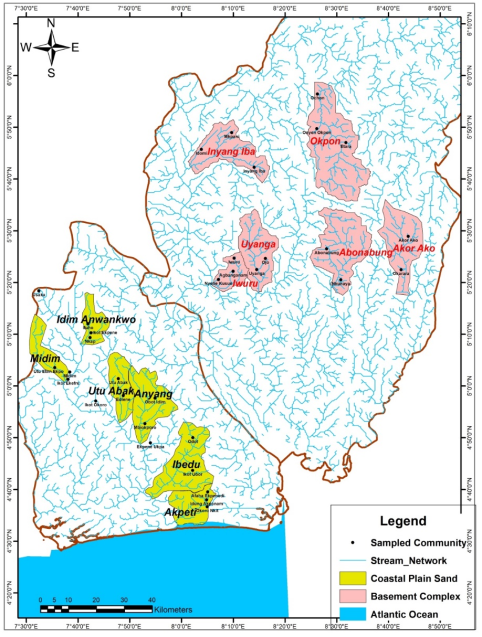
The morphological characteristics of the study area were assessed using the acquired digital elevation model (DEM) and Landsat imageries. Six matured watersheds were purposively selected from each geological formation (six in Coastal Plain Sands and six in Basement Complex), making a total of twelve (12) watersheds. These cut across Idim Awankwo, Midim, Utu Abak, Anyang, Ibedu and Akpeti watersheds in the Coastal Plain Sands in the Kwa Iboe River and Iwuru, Uyanga, Abonabung, Akor Ako, Okpon and Inyang Iba watersheds in the Basement Complex in Cross River (Figure 2).
Figure 2. The Study Area Showing Sampled Watershed and Communities.
In characterizing the basin, the 2024 ASTER DEM of the sub-catchment area was downloaded from the USGS website and used for the stream network. The stream network was extracted using ArcGIS 10.8 software via the spatial analyst toolbox on ArcMap. Using the clipped DEM of the catchment, hydrology was selected from the spatial analyst toolbox, the DEM was filled through the fill tool, flow direction and flow accumulation was determined still on the ArcMap menu. The Strahler stream ordering method was adopted in the stream ordering and was converted from raster to vector using the stream to feature function on the hydrology toolbox. The projection type was UTM and spheroid of WGS 1984. The datum was Minna datum, UTM zone 32N and the pixel size was 30 meter.
Areal characteristics such as basin area, perimeter, stream length, etc. was extracted from the attribute tables of the watershed in ArcGIS (Table 1) while linear and relief features were calculated using the respective equations as shown in Table 2. In comparing for the significant differences in the morphological characteristics of the two geological formations, independent t-test statistical technique was adopted. The goal is to find out whether a significant difference between two samples truly implies a difference between the means of the parent population.
Table 1. Parameters for Areal Drainage Classification in the watersheds.

S/N

Parameters

Formulae

1

Basin Area

Area from which water drains to a common stream and boundary determined by opposite ridges (GIS Analysis).

2

Basin Perimeter

Outer boundary of drainage basin measured in kilometers (GIS Analysis).

3

Basin Length

The straight line from the mouth of the basin to the farthest point on the basin perimeter (GIS Analysis).

4

Form Factor

F r = A/ L2. Fr = Form factor, A = Basin area, L = Basin length

5

Elongation Ratio

Re= √A /π / Lb

Where, A= Area of the basin (Km2) Lb=(Maximum) Basin length (Km) π =3.142

6

Circulatory Ratio

Rc = 4πA/ P2

Where, A = Basin area (Km2) and P= Perimeter of the basin (Km) π=3.142

7

Drainage Density

Dd = Lμ/A

Where, Dd = Drainage density (Km/Km2) Lμ = Total stream length of all orders and A = Area of the basin (Km2).

8

Stream Frequency

Fs = Nμ/A

Where, Fs = Drainage frequency (df). Nμ = Total no. of streams of all orders and A = Area of the basin (Km2).

9

Leminiscate Ratio

K = L2 / 4A Where L = Length of the basin and A = Area of the basin

10

Constant Channel Maintenance

C = 1/Dd

Where Dd = Drainage Density (Is the reciprocal of drainage density)

11

Drainage Texture

R Nu/PR =Drainage texture, N =Number of streams, P= Drainage perimeter

12

Infiltration Number (drainage intensity)

If = Dd × Fs

Where, Dd = Drainage density (Km/Km2) and Fs = Drainage frequency. (Also known as drainage intensity)

Source: Adapted from the work of and
Table 2. Parameters for Linear and Relief Classification of the watersheds.

S/N

Feature

Parameters

Formulae

13

Linear Features

Stream Order

Hierarchical rank (GIS Analysis)

14

Bifurcation Ratio

Rb = Nμ / Nμ +1

Where, Rb = Bifurcation ratio, Nμ = No. of stream segments of a given order and Nμ +1= No. of stream segments of next higher order.

15

Mean Bifurcation Ratio

Rbm = Average of bifurcation ratios of all orders

16

Total Stream Length

GIS Analysis (Length of all the stream km)

17

Mean Stream Length

Lsm = Lμ/Nμ

Where, Lμ = Total stream length of order ‘μ’ Nμ = Total no. of stream segments of order ‘μ’

18

Stream Length Ratio

RL= Lsm / Lsm-1

Where, Lsm=Mean stream length of a given order and Lsm-1= Mean stream length of next lower order

19

Length of Overland Flow

Lg=1/DD

Where, DD=Drainage Density (Km/Km2)

20

Relief Feature

Basin Relief or Local Relief

H = Z – z

Where, Z = Maximum elevation of the basin (m) and z = Minimum elevation of the basin (m)

21

Relief Ratio

Rr = H / Lb

Where, H = basin relief (m) and Lb = Basin length (m)

22

Basin Slope

GIS Analysis

23

Ruggedness Number

R = Bh/Dd Where, Bh=Basin relief, Dd=Drainage density

Source: Adapted from the work of and
6. Result
6.1. Summary of Morphometric Characteristics of Basement Complex and Coastal Plain Sands
Table 3. Linear Aspects of Watersheds in BC and CPS.

Parameter

Basement complex (BC)

Coastal Plain Sands (CPS)

Mean

Range

Mean

Range

No. of order 1

32.83

11-53

16.5

7-34

No. of order 2

7.67

3-14

3.83

2-7

No. of order 3

1.83

1-3

1.5

1-2

No. of order 4

1

1-1

1

-

Total No. of Stream

43

15-65

22.33

10-42

length of order 1 (km)

74.86

21.45-135.57

51.00

23.69-104.54

length of order 2 (km)

34.645

10.67-56.08

27.40

13.98-49.35

length of order 3 (km)

18.235

3.8-50.32

14.95

1.84-33.14

length of order 4 (km)

16.9875

12.22-22.05

15.20

7.4-19.75

Total Stream Length

139.065

45.9-241.97

103.48

42.53-206.76

Total mean stream length

37.41

7.15-80.66

27.34

14.18-51.7

Mean stream length 1 (lu1)

2.33

1.7-3.51

1.75

0.75-2.96

Mean stream length 2 (lu2)

4.745

2.7-6.46

4.96

1.46-12.51

Mean stream length 3 (lu3)

5.00

1.9-6.62

5.95

3.33-8.28

Basin length (km)

28.53

13.9845.1

21.47

16.6-28.24

Axial width (km)

13.64

6.6-18.73

8.94

7.23-10.87

Bifurcation Ratio 1&2

4.71

1.57-7.43

4.07

2.67-6.8

Bifurcation Ratio 2&3

4.805

2.33-11

2.58

1.5-3.5

Bifurcation Ratio 3&4

2.25

2-3

2

2-2

Mean Bifurcation Ratio

4.29

3.33-7.9

2.88

2.06-4.1

Source: Researcher’s Computation Using GIS (2025)
Table 3 shows the summary of the morphometric characteristics (linear aspects) of BC (Basement Complex) and CPS (Coastal Plain Sands). In BC, the number of stream order ranged between 11-55 with an average of 32.83 while in CPS it ranges between 7-34 with an average of 16.5. More so, the total stream length (measured in kilometres) in BC ranged between 45.9-241.97 while it was limited to between 42.53-206.76 in CPS. This results in a total mean length of 37.41 and 27.34 in BC and CPS respectively. The bifurcation ratio of BC between order 1 and 2 ranges between 1.57-7.43 while that of order 2 and 3 was between 2.33-11 with a mean bifurcation ratio of 4.29. Alternatively, bifurcation ratio in CPS ranges between 2.67-6.8 between order 1 and 2 but reduces to a range of 1.5-3.5 between order 2 and 3 with a mean bifurcation ratio of 2.88.
Bifurcation Ratio (Rb) is an indicator of the complexity and degree of dissection of a catchment Area. The lower bifurcation ratio in the CPS indicates sub basins in which the geologic structure does not exercise a dominant influence on the drainage pattern; the reverse is the case in BC. Thus, it can be deducted that in the CPS, the watersheds recorded less influence from the geological structure of the basins, making the soil have loose particles and highly susceptible to infiltration and highest level of stream extinction. This supports the observable disparity on the basin resilience as one traverse along the river course. It, therefore, remains necessary to note that the geological feature is a function of basin resilience.
Table 4. Areal Features of the Watersheds in Basement Complex and Coastal Plain Sands.

Indicator

Basement Complex

Coastal Plain Sands

Mean

Range

Mean

Range

Area (km2)

317.44

107.4-559.92

177.79

109.79-327.79

Perimeter (km)

89.60

49.32-123.45

64.48

54.31-95.02

Form Factor

0.41

0.28-0.55

0.38

0.28-0.52

Elongation Ratio

0.36

0.3-0.42

0.23

0.17-0.32

Circulatory Ratio

0.48

0.39-0.55

0.41

0.15-0.57

Drainage Density

0.44

0.42-0.45

0.57

0.39-0.72

Stream Frequency

0.14

0.12-0.16

0.27

0.089-0.5

Drainage Intensity

0.06

0.05-0.07

0.28

0.18-0.39

Leminiscate Ratio

0.66

0.45-0.91

0.68

0.48-0.9

Drainage Texture

0.46

0.3-0.62

0.74

0.2-1.23

Source: Researcher’s Computation Using GIS (2025)
Table 4 shows areal features of BC and CPS. Area aspect is a measure of the basin geometry. It has important control over the geometry of the stream network and thus influences the shape of the hydrograph. In BC, basin area ranges between 107.4-559.92km2 while in CPS it ranges between 109.79-327.79km2. The elongation ratio in BC ranged between 0.3-0.42 and in CPS was between 0.17-0.32 which means that both watersheds recorded elongated shapes. However, the circularity recorded a mean of 0.48 in BC and a range of 0.39-0.55, while that of CPS ranges between 0.15-0.57 with an average of 0.41. Drainage density in BC ranged between 0.42-0.45 and in CPS ranges between 0.39-0.72. The circularity ratio was observed to be higher in BC than CPS. In the Basement Complex, the result shows complicated values, high circularity ratio and this is because of the presence of a combination of lithological formations, leading to differential erosion and subsequently to watershed displacement . CPS have lower relief range with its maximum relief ranging between 25-124m while the maximum relief in BC ranges between 140-845m. This indicates a relative low relief in CPS compared with BC. This implies that catchments in CPS show longer time to peak. It means basins produce a flatter peak of direct runoff for a longer duration.
Other morphological characteristics of a watershed like form factor have powerful impacts on watershed hydrology as it forecast the flow intensity of a given river basin. In this study, form factor was lowest in CPS ranging between 0.28-0.52 (mean = 0.38) but significantly higher in BC with a range of 0.28-0.55 (mean=0.41). Catchments with low (Ff) value (like what is obtainable in CPS) tend to be elongated, which give low peak flows for longer duration, and thus reduce the chance for the basin to flood. On the other hands, catchments with high (Ff) values experience high peak flow of short duration. Meanwhile, low drainage densities are often associated with widely spaced streams due to the presence of less resistant materials (lithologies or rock types), or those with high infiltration capacities .
Table 5. Relief Features of the Watersheds in Basement Complex and Coastal Plain Sands.

Parameter

Basement Complex

Coastal Plain Sands

Indicator

Mean

Range

Mean

Range

Highest Elevation (m)

471.67

140-845

53.26

25-124.12

Lowest Elevation (m)

60.00

5-125

14.77

7-34.76

Basin Relief

411.67

130-805

38.48

10-89.36

Relative relief

0.00

0.0016-0.0065

0.16

0.0013-0.31

Relief ratio

0.01

0.0044-0.022

0.70

0.00032-1.49

Ruggedness Number

0.18

0.054-0.346

0.02

0.0063-0.035

Source: Researcher’s Computation using GIS (2025)
Relief Aspects is a measure of the basin relief (H), Relief ratio (Rh), relative relief (Rhp) and ruggedness number (Rn). The relief ratio is the expression of the overall steepness of a basin, which indicates the intensity of erosion processes operating on slopes of the basin. The basin relief was highest in BC ranging between 130-805m while that of CPS was very low ranging between 10-89.36m (Table 5).
In a nutshell, streams in the ancient basement complex rocks of Cross River State have restricted area, high values of basin relief and high bifurcation ratio due to inability of streams to erode easily, unlike the weak sedimentary rocks. It is obvious that the morphometric properties of streams differ significantly between the ancient rocks and the sedimentary formations. This study has also shown that differences in geology constitutes a constraint on the degree of interdependence amongst the morphometric attributes of drainage basins and that the mature streams in the rugged topography of the Cross-River system are characterized by elongated shape.
6.2. Testing of Hypothesis on the Differences on Morphological Parameters Between BC and CPS
The morphometric parameters (linear, areal and relief features) in both basement complex and coastal plain sands were used to compare the differences in their characteristics in relation to stream extinction. The morphometric parameters are summarized in Table 6.
Formulated Hypothesis
Ho1: There is no significant difference in the morphological parameters of Basement Complex and Coastal Plain Sands as they relate to stream extinction.
Table 6. Independent Samples Test.

Levene's Test for Equality of Variances

t-test for Equality of Means

F

Sig.

t

df

Sig. (2-tailed)

Mean Difference

Std. Error Difference

Parameters

Equal variances assumed

7.84

0.131

1.528

70

0.007

30.07924

19.68066

Equal variances not assumed

1.528

41.967

0.134

30.07924

19.68066

Source: Analysis from Field Data using SPSS (version 25.0)
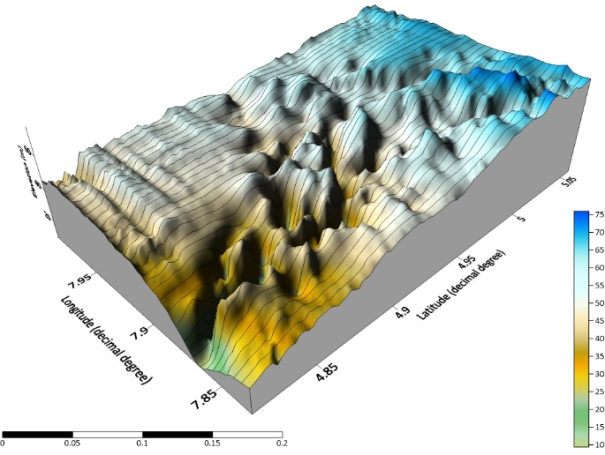
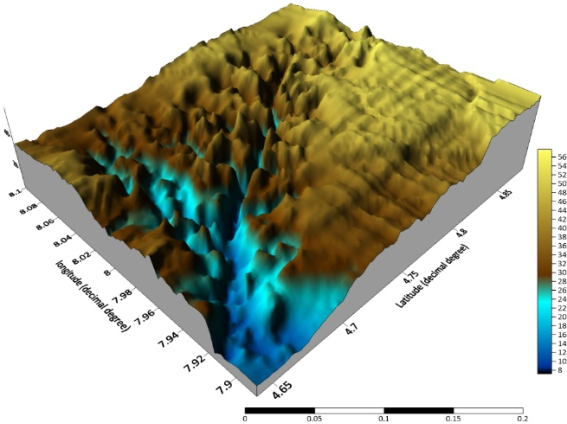
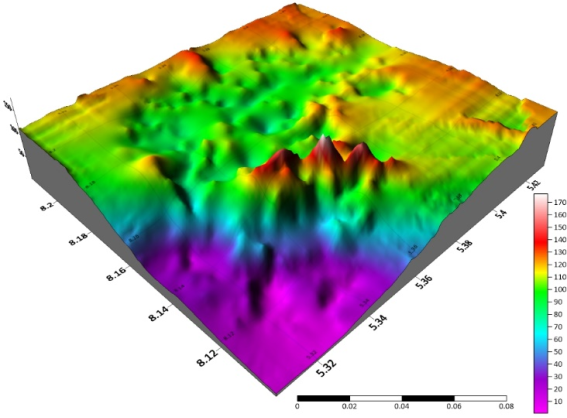
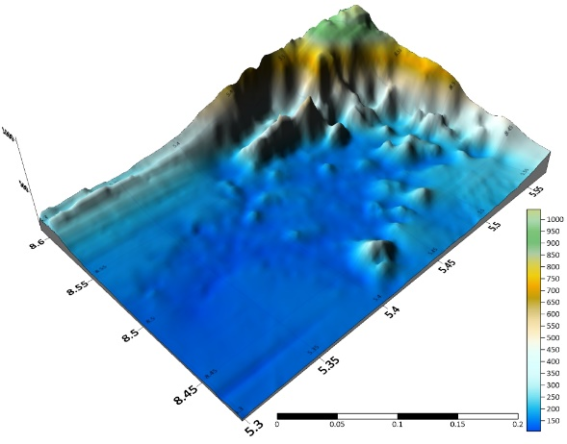
Table 6 shows the Levene’s value of 0.131 which indicates the suitability of independent t-test analysis. The main result yielded a t-value of 1.528, degree of freedom (df) of 70 and p-value of 0.007. The result (p<0.05) is an indication that there is a significant difference in the morphological parameters of Basement Complex and Coastal Plain Sands as they relate to stream extinction. The 3D surface models shows that sub-catchments in CPS exhibited convexity nature (Figure 3 and Figure 4) while that on BC were mostly concave due to the high length of overland flow experience in CPS (Figure 5 and Figure 6).
Figure 3. 3D Model of Anyang Watershed in CPS.
Figure 4. 3D Model of Ibedu Watershed in CPS.
Figure 5. 3D Model of Iwuru Watershed in BC.
Figure 6. 3D Model of Abonabung Watershed in BC.
6.3. Discussion of Result
The result of the study shows that streams in the ancient Basement Complex rocks of Cross River State have restricted area, high values of basin relief and high bifurcation ratio due to inability of streams to erode easily, unlike the weak sedimentary rocks. It is obvious that the morphometric properties of streams differ significantly between the ancient rocks and the sedimentary formations. This work corresponds with the study of that streams in the ancient basement complex rocks of Cross River State have restricted area, high values of basin relief and high bifurcation ratio due to inability of streams to erode easily, unlike the weak sedimentary rocks. Hence, the morphometric properties of streams differ significantly between the ancient rocks and the sedimentary formations. It also corresponds with the work of that in the Basement Complex, there are complicated values, high circularity ratio and this is because of the presence of a combination of lithological formations, leading to differential erosion and subsequently to watershed displacement. It also affirmed that Bifurcation Ratio (Rb) is an indicator of the complexity and degree of dissection of a watershed. The work also corresponds with the result of that low drainage densities are often associated with widely spaced streams due to the presence of less resistant materials (lithologies or rock types), or those with high infiltration capacities.
The result also corresponds with the work of and who admitted that streams are disappearing in the environment, attributing it causes to both physiographic and anthropogenic factors. It also affirmed with which put it that the terrain properties (e.g. slope, land cover, roughness, etc.) have a role in shaping different streams which in turn affect the extent of stream disappearance. This finding agreed with the work of which argued that the morphometric characteristics at the watershed scale may contain important information regarding its formation and development because it is a representation of hydrologic and geomorphic processes in a watershed. Drainage pattern concept draws inferences on the extent of stream extinction.
7. Summary
The study has confirmed that the geological formation to a very large extent influences the morphological characteristics of the watersheds which triggers its extinction as the rate of extinction is more pronounced in CPS. The result shows that twenty-six (26) streams have extincts across the six sub-catchments in CPS with the highest number recorded in Ibedu watershed followed by Anyang and Midim watersheds respectively. Similarly, a total of nineteen (19) streams are threathen in CPS with majority of them in Ibedu and Anyang watershed. In Basement Complex, seventy-nine (79) streams have extincts across the six sub-catchments with the highest number recorded in Okpon watershed followed by Abonabang and Akor Ako respectively while a total of forty-eight (48) streams are threatened in BC mostly in Okpon and Akor Ako watersheds.
Morphologically, result shows that the streams in the ancient basement complex rocks of Cross River have restricted area, high values of basin relief and high bifurcation ratio due to inability of streams to erode easily, unlike the weak sedimentary rocks. Hence, the morphometric properties of streams differ significantly between the ancient rocks and the sedimentary formations. This study has also shown that differences in geology constitutes a constraint on the degree of stream extinction in the two geologies under studies.
8. Recommendation
In view of the findings reached and the implications discussed during this work, it was recommended that since the Coastal Plain Sands is highly prone to stream extinction, desilting the stream channel should be given a priority by stakeholders which include government, NGOs, communities and private individuals. The recommended dredging should start with Idim Ediene, Idim Anwankwo, idim Midim as a step toward stream restoration.
Abbreviations

NGOs

Non-governmental Organizations

CPS

Coastal Plain Sands

BC

Basement Complex

Rb

Bifurcation Ratio

DEM

Digital Elevation Model

UTM

Universal Traverse Mercator

WGS

World Geodetic System

3D

Three Dimension

Author Contributions
Unyime Udoette Saturday: Conceptualization, Data curation, Formal Analysis, Investigation, Methodology, Writing – original draft, Writing – review & editing
Emmanuel Peter Udofia: Investigation, Project administration, Software, Supervision, Validation, Writing – review & editing
Conflicts of Interest
The authors declare no conflicts of interest.
References
[1] Edem, I., Uduak, C., Peter, A. and Usuah, E. (2012). Impacts of Exploitation and Gas Pipelines on Soils Along Qua Iboe River Estuary of Onna, Southeastern Nigeria. Advances in Applied Science Research 3(5): 2578-2585.
[2] Enoh, C. (2000). Man-Impact on Environment. In: Inyang, I. B. (ed.) South-Eastern Nigeria: Its Environment. Kaduna: Abaam Publishing Company.
[3] Eze, B. and Joel, E. (2010). Morphometric Parameters of the Calabar River Basin: Implication for Hydrologic Processes. Journal of Geography and Geology 2(1) 18-26.
[4] George, U. and Akpan, E. (2020). Assessing the Impacts of Coastal Activities on the Water Quality of Qua Iboe River Estuary, South-South, Nigeria. Nature and Science; 18(5): 50-64.
[5] Gupta, R. and Jindal, A. (2000). Influence of Buried Topography on Surface Drainage Pattern. International Journal of Remote Sensing, 21(2): 209-211.
[6] NiMeT (Nigerian Meteorological Agency) (2023) Seasonal Rainfall Prediction (SRP) Periodic Monitoring Report. Dated – Thursday, 28 December 2023: 18-19.
[7] NPC (National Population Census) (2006). 2006 Population Census Data of Akwa Ibom State, Nigeria; Abuja NPC: National Population Commission, 37 p.
[8] Pareta, K. and Pareta, U. (2011). Quantitative Morphometric Analysis of a Watershed of Yamuna Basin, India using ASTER (DEM) Data and GIS. International Journal of Geomatics and Geosciences, 2(1): 248-269.
[9] Saturday, U., Udosen, C., and Ubom, O. (2021) Drainage Network Characteristics of Order-3 Basins in the Sedimentary Rocks in Southeastern Nigeria: Implications on Hydrologic Processes. Conference Proceedings of the Association of Nigerian Geographers (ANG) 61st Annual Conference, held at the University of Calabar from 9th – 12th August 2021, 109 p.
[10] Tom, H. (2023) Why is the Euphrates River Drying Up and What Does It Mean? IFLScience. Retrieved from
[11] Udofia, E. P. (2010). Environmental Problems. In: Usoro, E. J. and Akpan, P. A. (eds) Akwa Ibom State: A Geographical Perspective. Enugu: Immaculate Publications Limited.
[12] Udosen, C. (2009) Environmental Constraints on the Interdependence of Drainage Basin Morphometric Properties in the Upper Cross River. Global Journal of Geological Sciences 7(2) 119 – 124.
[13] Udosen, C., Okon, M., Abasi-Ifreke, S. and Malachy, U. (2021) Morphometric Analysis of Lower Enyong Creek Basin in South-Eastern Nigeria; its Implications for Applied Studies. Global Journal of Pure and Applied Sciences, 27(1): 10-14.
Cite This Article
  • APA Style

    Udofia, E. P., Saturday, U. U. (2025). Geological Formations and the Quagmire of Stream Extinction in Southern Nigeria. Engineering Science, 10(3), 92-103. https://doi.org/10.11648/j.es.20251003.12

    Copy | Download

    ACS Style

    Udofia, E. P.; Saturday, U. U. Geological Formations and the Quagmire of Stream Extinction in Southern Nigeria. Eng. Sci. 2025, 10(3), 92-103. doi: 10.11648/j.es.20251003.12

    Copy | Download

    AMA Style

    Udofia EP, Saturday UU. Geological Formations and the Quagmire of Stream Extinction in Southern Nigeria. Eng Sci. 2025;10(3):92-103. doi: 10.11648/j.es.20251003.12

    Copy | Download

  • @article{10.11648/j.es.20251003.12,
      author = {Emmanuel Peter Udofia and Unyime Udoette Saturday},
      title = {Geological Formations and the Quagmire of Stream Extinction in Southern Nigeria},
      journal = {Engineering Science},
      volume = {10},
      number = {3},
      pages = {92-103},
      doi = {10.11648/j.es.20251003.12},
      url = {https://doi.org/10.11648/j.es.20251003.12},
      eprint = {https://article.sciencepublishinggroup.com/pdf/10.11648.j.es.20251003.12},
      abstract = {Geology plays a key role in determining the behavior of the ecosystem including its streams network and a better understanding of this concept is the first step toward ecosystem and water sustainability. Hence, this study examines geological formations and the quagmire of stream extinction in Southern Nigeria. Two different geological formations in Southern Nigeria were considered in this study which include the Coastal Plain Sands using Kwa Iboe River in Akwa Ibom State and Basement Complex in some parts of Cross River State. Six matured watersheds were purposively selected from each geological formation (six in Coastal Plain Sands and six in Basement Complex), making a total of twelve (12) watersheds. These cut across Idim Awankwo, Midim, Utu Abak, Anyang, Ibedu and Akpeti watersheds in the Coastal Plain Sands in the Kwa Iboe River and Iwuru, Uyanga, Abonabung, Akor Ako, Okpon and Inyang Iba watersheds in the Basement Complex in Cross River. The result of the summary of the morphometric characteristics shows lower bifurcation ratio in the CPS indicating watersheds in which the geologic structure does not exercise a dominant influence on the drainage pattern while the reverse is the case in BC. In area aspect, the result shows complicated values and high circularity ratio in BC due to the presence of a combination of lithological formations, leading to differential erosion and subsequently to watershed displacement. Statistical analysis using independent t-test analysis shows a p-value of 0.007 which is an indication that there is a significant difference in the morphological parameters of Basement Complex and Coastal Plain Sands as they relate to stream extinction. The summary of the study indicates that streams in the ancient basement complex rocks of Cross River State have restricted area, high values of basin relief and high bifurcation ratio due to inability of streams to erode easily, unlike the weak sedimentary rocks. More so, streams in the CPS recorded less influence from the geological structure of the basins, making the soil have loose particles and highly susceptible to infiltration and highest level of stream extinction. This supports the observable disparity on the basin resilience as one traverse along the river course. Hence, it was recommended that since the CPS is highly prone to stream extinction, desilting the stream channel should be given a priority by stakeholders.},
     year = {2025}
    }
    

    Copy | Download

  • TY  - JOUR
    T1  - Geological Formations and the Quagmire of Stream Extinction in Southern Nigeria
    AU  - Emmanuel Peter Udofia
    AU  - Unyime Udoette Saturday
    Y1  - 2025/12/09
    PY  - 2025
    N1  - https://doi.org/10.11648/j.es.20251003.12
    DO  - 10.11648/j.es.20251003.12
    T2  - Engineering Science
    JF  - Engineering Science
    JO  - Engineering Science
    SP  - 92
    EP  - 103
    PB  - Science Publishing Group
    SN  - 2578-9279
    UR  - https://doi.org/10.11648/j.es.20251003.12
    AB  - Geology plays a key role in determining the behavior of the ecosystem including its streams network and a better understanding of this concept is the first step toward ecosystem and water sustainability. Hence, this study examines geological formations and the quagmire of stream extinction in Southern Nigeria. Two different geological formations in Southern Nigeria were considered in this study which include the Coastal Plain Sands using Kwa Iboe River in Akwa Ibom State and Basement Complex in some parts of Cross River State. Six matured watersheds were purposively selected from each geological formation (six in Coastal Plain Sands and six in Basement Complex), making a total of twelve (12) watersheds. These cut across Idim Awankwo, Midim, Utu Abak, Anyang, Ibedu and Akpeti watersheds in the Coastal Plain Sands in the Kwa Iboe River and Iwuru, Uyanga, Abonabung, Akor Ako, Okpon and Inyang Iba watersheds in the Basement Complex in Cross River. The result of the summary of the morphometric characteristics shows lower bifurcation ratio in the CPS indicating watersheds in which the geologic structure does not exercise a dominant influence on the drainage pattern while the reverse is the case in BC. In area aspect, the result shows complicated values and high circularity ratio in BC due to the presence of a combination of lithological formations, leading to differential erosion and subsequently to watershed displacement. Statistical analysis using independent t-test analysis shows a p-value of 0.007 which is an indication that there is a significant difference in the morphological parameters of Basement Complex and Coastal Plain Sands as they relate to stream extinction. The summary of the study indicates that streams in the ancient basement complex rocks of Cross River State have restricted area, high values of basin relief and high bifurcation ratio due to inability of streams to erode easily, unlike the weak sedimentary rocks. More so, streams in the CPS recorded less influence from the geological structure of the basins, making the soil have loose particles and highly susceptible to infiltration and highest level of stream extinction. This supports the observable disparity on the basin resilience as one traverse along the river course. Hence, it was recommended that since the CPS is highly prone to stream extinction, desilting the stream channel should be given a priority by stakeholders.
    VL  - 10
    IS  - 3
    ER  - 

    Copy | Download

Author Information